Thursday, February 23, 2017

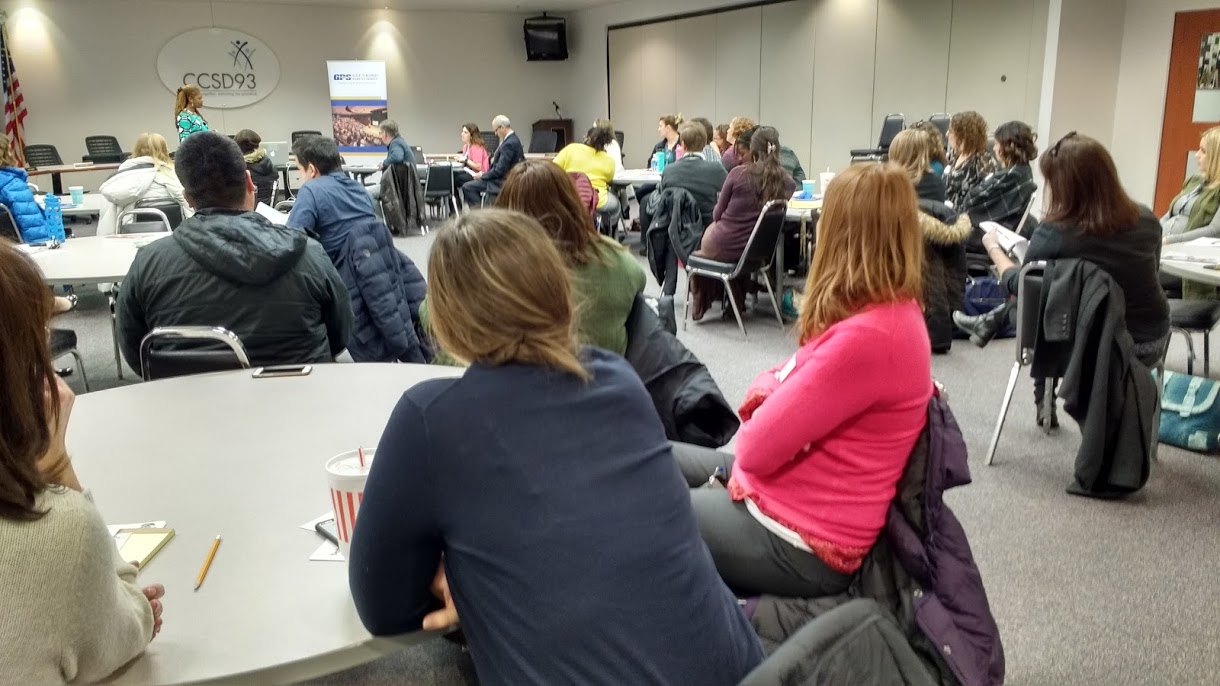
Drew Dudley speaks to parents and students during Glenbard's Live Life Well Week


On Feb 22 and 23 Drew Dudley addressed students at all Glenbard high schools as part of Live Life Well Week.

Drew Dudley spoke to students as part of Live Life Well Week.


On Feb. 22, the Glenbard Parent Series hosted Dudley in a program at the College of DuPage entitled Everyday Leadership: Celebrating he Simple Actions That Improve Each Others Lives.

Glenbard South parent Ann Marie Andexler shared this takeaway:

Drew Dudley with Glenbard South
parent Ann Marie Andexler
"If we hope to matter, lead and make a difference we need to plan for it.  Know why you matter. Know and define your core values and create opportunities to live them. Once established youth can use these core values to help them in their decision making. Work hard to make your grades extraordinary and then work twice as hard to make them the least impressive thing about you. "

Drew Dudley shares his slides from his leadership presentation to parents:

Creating Cultures of Leadership Slides  


Resource links (click on text): 

Robert Crown Center for Health presents Raising Healthy Teens: Sex Ed on February 16 2017


The Glenbard Parent Series: (GPS) Navigating Healthy Families presented Raising Healthy Teens in the Digital Age: Get the Conversation Started with the Robert Crown Center for Health Education on Thursday, February 16th, at the Marquardt Administration Center. Becky McFarland Community Initiatives Coordinator for the DuPage County Health Department shared this take-away:

Becky McFarland
Community Initiatives Coordinator

Parents should have ongoing discussions with their kids so that when they need to make their own decisions they have a solid foundation to make the healthy choice. Keep your sense of humor and use the media and real life situations as a way to begin these challenging conversations. Be clear about your values and talk facts rather than beliefs. Teens needs accurate information to help protect them from the pressures that are real. Be open to their questions so you can be an askable adult!


Resource Links (click)


Notes: Raising Healthy Teens in a Digital Age: Sexual Health Workshop for Parents (pdf)

Website for Robert Crown Center for Health Education

Handout: Sex Education in the Digital Age Parent Resources (pdf)

Tuesday, February 14, 2017

Robert Crown Center for Health presents Raising Healthy Teens: Substance Abuse Prevention on February 8

On Feb. 8, the Glenbard Parent Series and Robert Crown Center for Health presented Raising Healthy Teens in the Digital Age/Drug Abuse Prevention.

Parent appreciates Raising Healthy Teens tips

Mia Cosillo
Glenbard South parent Mia Cosillo shared this takeaway:  "Start the conversation early and keep it going. Set boundaries, and be prepared to follow them. Know the risk level of your children. Model healthy ways to handle stress. We have to understand the reality of their world. Social media can make teens feel isolated, leading to a heightened sense of being unworthy. Know their friends. It was interesting to learn about the social host laws that hold parents accountable - if they knew or should have known about alcohol use in their home, if parents provided the alcohol or not, or if parents were home or not, they are legally responsible."

Event Summary

Get the Conversation started focused on the reality of the multiple messages that children receive daily that form and influence their decision-making.  So where do parents come in?

We have to understand the reality of their world...sometimes the isolation that teens may feel - as different and not a part of their school experience - the reality is they feel a "heightened sense of being unworthy"  Figuring out where I fit can lead to trying alcohol or other substances...how do parents talk to their children before experimentation begins?

It starts early...5th grade...8th grade and by 12th grade majority of kids try drinking or smoking.

What's the Perception that parents have of their child's use....

Monitoring the Future Study 2010
Mott Children's Hospital National Poll on Children's Health 2011:

Parent: 5% believe their teen used marijuana
Children: 28% self-report using

Parent:10% believe their teen drank alcohol
Children: 52% self report drinking

Parent: 3% admit giving their child medication NOT prescribed for them
Children: 22% say they were given medicine not meant for them by their parents

How do we get the message out to parents that we begin healthy conversations with our kids when
they are young...we have to be more self-aware of our own habits...drinking and how we choose to
handle stress...

Set boundaries...and be prepared to follow them
Ongoing conversation...
Supportive relationships...
Know the risk level of your children...
Know their friends... social hosting


One more...don't think you child won't experiment. They are kids...wired to test
limits and needing your guidance and early conversation and trust.

Bottom line is this truth:  Teens agree that YES  their parents would feel youth's using drugs or alcohol is "wrong" or "very wrong"

Contact: Robert Crown Center for Health Education Kris Adzia, Director of Education  kadzia@robertcrown.org

Resource Links

You Tube Video:  Why are Teens so Moody?

Website for Robert Crown Center for Health Education

Raising Healthy Teens Drug Prevention in the Digital Age Handout


Friday, February 3, 2017

Pamela Randall-Garner speaks on Social Emotional Learning and Restorative Justice

On Feb. 2 the Glenbard Parent Series organized a workshop on Social Emotional Learning and Restorative Justice:  The Skills of Building Peer Relationships for a Safe School Climate with Pamela Randall-Garner of CASEL (Collaborative for Academic, Social, and Emotional Learning).


Glenbard West parent Michelle Nothvogel shared this take-away.  " It was great to learn about restorative practices and social discipline happening in our schools with its approach to build empathy, compassion and its focus on how ones behavior affects others. Being reminded about the importance of trust, humor, and making sure everyone has a voice and is heard was also very useful."


Resources:


Wednesday, January 25, 2017

Author David Sheff speaks to GPS on Jan 25 & 25 on "What Happened to my Beautiful Boy"

A Fathers Journey Through His Son's Addiction


David Sheff
From David Sheff:  "Drug abuse is America’s greatest challenge—it impacts every other societal problem you can name. We’ve ignored it because it has been our great shame. We’ve viewed drug use
as a problem of morals, character, and criminality rather than what it is: a health crisis. As a result,
drugs are now killing more people in our nation than any other non-natural cause. A person is dying every 19 minutes. We can change the course we’re on, but only when we reject the status quo and adopt new prevention strategies that address the underlying causes of drug use. When we do, we will make our cities safer, help families stay together, help our children grow up healthier, and save countless lives."

Parent appreciates honest insights re: substance abuse

Glenbard West parent Molly Murphy 
The Glenbard Parent Series presented "What Happened to My Beautiful Boy; A Father's Journey Through His Son's Addiction" at Glenbard North on Jan. 24.  Glenbard West parent Molly Murphy shared this takeaway: "David Sheff shared a raw and honest program, reminding us that addiction is a medical disease and not a character flaw. We need to get past the stigma of mental illness, depression, anxiety disorders and substance abuse and be better informed about their connection. We need to not only share the success of our kids but also their struggles.  Listen more, act early and love our children for who they are and not who we want them to be."


Friday, December 9, 2016

GPS event helped parent learn new social media trends

The Glenbard Parent Series: (GPS) Navigating Healthy Families presented Tweens,Teens and the Tech Trends of Today with Liz Repking on Thursday, December 8 at the Community Consolidated School District 93 in Bloomingdale


Liz Repking and Lynn Dugan
Glenbard West parent Lynn Dugan shared the following takeaway:  "I hope to teach my teens to make good decisions regarding social media and cyberspace in general but the landscape is challenging because it is ever-changing. Of course, we need to model good online behavior and help kids understand 'What goes online stays online.' This presentation gave me a chance to learn new things (have you heard of Kik?) and equipped me for the important dialogue I want to continue with my kids."


View the presentation on the Glenbard Parent Series YouTube Channel here

Liz Repking's Cyber Safety Consulting web site here

Wednesday, December 7, 2016

Strategies for Improving Executive Function Skills to Plan, Organize, and Problem Solve for School Success with Sarah Ward

The Glenbard Parent Series: (GPS) Navigating Healthy Families presented Strategies for Improving Executive Function Skills to Plan, Organize, and Problem Solve for School Success with Sarah Ward on Tuesday, December 6 at Glenbard South.  

Sarah Ward spoke to a packed house of students and parents at the GPS  Dec. 6.  Two students share their take aways:

Glenbard South Senior-
Thank you GPS for bringing in a speaker who confirmed what I have been trying to convince my father of- forever.  Listening to music helps me drown out the other distractions when doing homework. So great to have my dad now understand, since he heard it from an expert. Nice!!

Glenbrd West Junior-

What a helpful program for all students. So glad I attended. I will now " plan backward to execute forward".  This won't be my last GPS.

Glenbard North parent Cindy Allston shared the following take-away:  


"It was fascinating to hear that kids with Executive Functioning Deficits have time blindness and are unable to see the future.  We need to help them become a future stretcher to actually visualize the passage of time, so they can plan and go toward that future/project completion. Consider shading in "time to work" on a wall clock to actually make time visible, was one helpful strategy.  And always plan backward to execute forward."


Resources


Friday, November 18, 2016

GPS event with Julie Lythcott-Haims "How to Raise an Adult" - takeaways and resources


On Nov. 16 and 17, former Stanford University dean Julie Lythcott-Haims presented Glenbard Parent Series programs based on her best-selling book, "How to Raise an Adult:  Break Free of the Overparenting Trap and Prepare Your Kids for Success."

Glenbard East parent Ruth Vitale (left)
with  Julie Lythcott-Haims and
Glenbard West Principal Peter Monaghan 
Glenbard East parent Ruth Vitale shared the following takeaway: "When we over-parent, it sends a message to our kids, `You can't do this without me.' It also deprives them of the opportunity to feel good about their own accomplishments (which can lead to depression) and learn important life skills like self-efficacy. Our job as parents is to teach our children to become problem-solvers and to ultimately put ourselves out of a job."

Paul Gordon, Glen Ellyn School District 41 superintendent, attended the presentation on Nov. 17 and shared this takeaway: "We have to increasingly and deliberately put opportunities for our students' independence before them.  Parents succeed when we have raised our children to successful adulthood."


Resources


Sunday, October 30, 2016

Our Friends at The Family Institute at Northwestern University shares with Family Tip on Emotions

Source:  http://www.family-institute.org/about-us/tip-of-the-month/


OCTOBER/NOVEMBER 2016

Naming Emotions

Your daughter comes home in tears. She can barely choke out words to describe the mean things some girls said to her on the school bus. You listen to her story and try to comfort her. If you're really skilled, you'll offer her attunement (Are You Okay? March, 2014).

After a couple months practicing for his first driver's license, your son fails the behind-the-wheel test at the motor vehicle department. On the way home, you sense his distress as he complains about the unfair examiner and how he deserved to pass. You try to comfort him.

Recent research suggests that there's something else -- something enormously helpful -- that you can do that may reduce the intensity and duration of a child's distress: coach your kids to identify and name the specific emotions they're feeling during moments of emotional pain.

Studies have found that when people identify and specifically name their emotions, they are "less likely to be overwhelmed in stressful situations."i That's because when we use precise labels for our feelings, we understand more about what's happening to us emotionally, which then can lead to identifying a smart (and healthy) course of action. Clearly labeled emotions become easier to regulate ("I'm sad" rather than "I feel bad," or "I'm disappointed" rather than "I'm really bummed out"). Once we know the feeling we're dealing with, we can tailor our response to it rather than just fall back on the customary habits we rely on in order to feel better (especially unhealthy habits like erupting into anger, turning to alcohol, bottling up the pain, bingeing on food, etc.)

People skilled at naming their feelings have been found to drink 40% less alcohol when stressedii, and are 20% to 50% less likely to retaliate with verbal or physical aggression against someone who has hurt them.iii Impressive evidence exists that teaching school-aged children to expand their understanding and use of precise emotion words improves both their social behavior as well as their academic performance.iv

If we're going to teach our kids to speak the language of emotions, we're going to need to speak the language ourselves. It doesn't require a huge lexicon; angry, sad, hurt, afraid, upset, disappointed, discouraged, guilty, and ashamed are the basics. Incorporate those words into your vocabulary, and when your kids are distressed, coach them to do the same.

i Kashdan, T.B., L.F. Barrett, P.E., McKnight. "Unpacking emotion differentiation: transforming unpleasant experience by perceiving emotion differentiation." Current Directions in Psychological Science, February 2015 vol. 24 no. 1, pp.10-16. doi: 10.1177/0963721414550708.

ii Kashdan, T. B., P. Ferssizidis, R.L. Collins, & M. Muraven. "Emotion differentiation as resilience against excessive alcohol use: An ecological momentary assessment in underage social drinkers." Psychological Science, 21, 2010. 1341-1347.

iii Pond, R. S., T.B. Kashdan, C.N. Dewall,  A.A. Savostyanova, N.M. Lambert, & F.D. Fincham. "Emotion differentiation buffers aggressive behavior in angered people: A daily diary analysis." Emotion, 12, 2012. 326-337.

iv Brackett, M. A., S.E. Rivers, M.R. Reyes, & P. Salovey. "Enhancing academic performance and social and emotional competence with the RULER feeling words curriculum." Learning and Individual Differences, 22, 2012, 218-224.

(c)2016
  

Monday, October 24, 2016

Patrick Donohue: Study Skills Now, Life Skills Forever: The Tools to Help Your Child Achieve - GPS Oct 17 event

K Parmar, a Glenbard North parent, offers this takeaway from GPS Oct 17 event featuring Patrick Donohue:

Pat's 5 Things Good Students Do--it's unfortunate when students do not have a good understanding on how their course grade is structured and what matters to the teacher, because this can literally make or break their grade for the semester no knowing what their overall grade consists of especially if teachers use categories. I was also impressed with the Pomodoro Timing and his Rewrite Shorty Notes techniques, and it's something I will have my children try to implement as part of their study skills.

As a parent, it's important when our children hit that bottom of the curve as Pat stated, that we take time to support and encourage our children to continue to face it, work hard, be persistent, be present, and give their all even when the outcome is unknown. It's important to help our children realize that they are going to be successful and the outcome is likely to be positive when they've prepared in this manner.

As parents, it's also important fir us to keep "failing"and "failure" separate and help our children understand the differences between the two as we encourage a growth mindset rather than a fixed mindset.

And my final takeaway from tonight: Besides the 5 things good students do to be successful in academics, much of Pat's presentation was on how to parent in an encouraging and supportive manner so that our children are motivated to be successful, and to develop and sustain a growth mindset throughout their lives, not just in academics in high school and college!